
NST, antepartum testing
Nonstress testing gives your care team a real-time view of your baby's heart rate, movement, and uterine activity. Quiet, noninvasive, and reassuring, usually in 20 to 30 minutes.

What is a nonstress test?
An NST records your baby's heart rate alongside their movements and any uterine activity. A reassuring pattern, small accelerations with movement, confirms your baby is getting the oxygen they need.
One records your baby's heart rate. The second records uterine activity. Both are external, nothing invasive.
You may be asked to press a marker each time you feel movement. No medication, no ultrasound exposure.
We look for at least two accelerations with movement in 20 minutes. That's a "reactive" tracing, the goal.
We communicate results the same day, with a clear next step if any is needed.
Deeper dive, optional
A nonstress test (NST) evaluates how the baby's nervous system and cardiovascular system respond to normal movement and activity inside the uterus. The test is based on an important physiologic principle: a healthy, well-oxygenated baby will usually have temporary increases in heart rate with movement.
The baby's heart rate is controlled by the autonomic nervous system, which includes both the sympathetic ("accelerating") and parasympathetic ("slowing") pathways. As the fetal nervous system matures and receives adequate oxygen, these systems create normal beat-to-beat variability and brief heart rate accelerations. These patterns are reassuring signs of normal neurologic function and oxygen delivery.
During the NST, an external ultrasound monitor measures the fetal heart rate while a second monitor records uterine activity. We evaluate several features of the tracing, including:
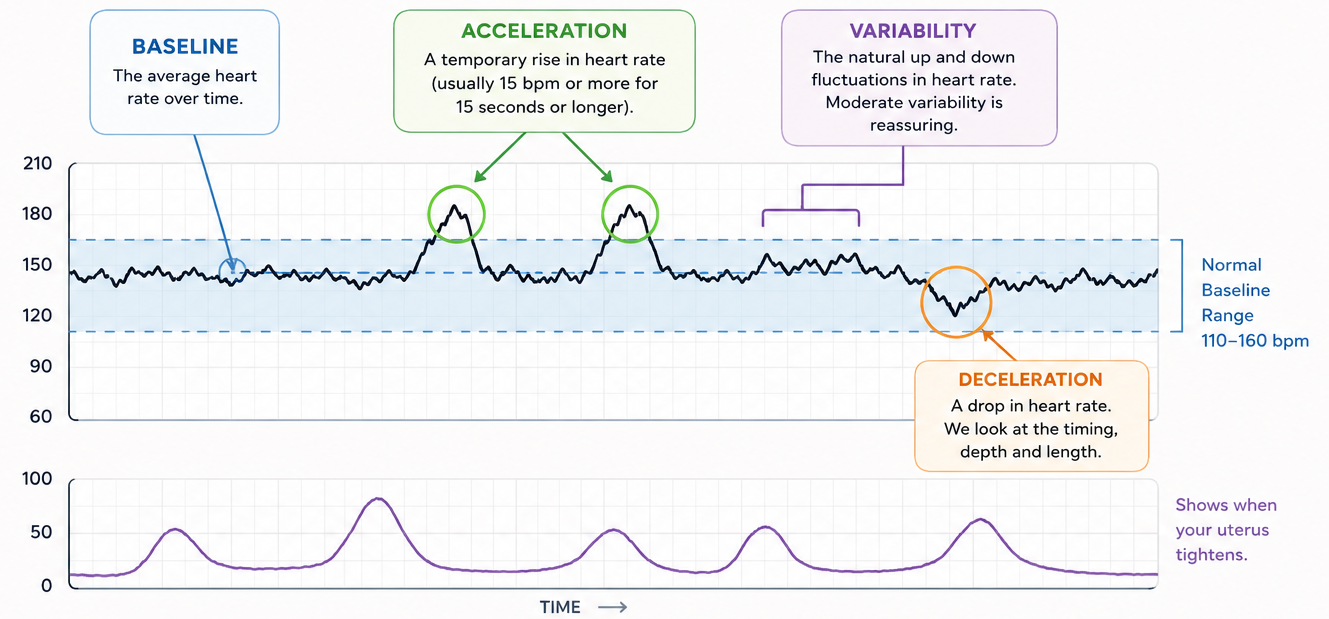
The features we look for on every tracing: baseline, accelerations, variability, and any decelerations, alongside the lower channel showing uterine activity.
A reactive NST occurs when the baby demonstrates expected accelerations over the monitoring period. This response suggests that the fetal brain, heart, and oxygenation status are functioning normally at that moment in time.
One of the most important aspects of the NST is variability. Moderate variability is considered a strong reassuring sign because it reflects an intact neurologic pathway between the brain and heart. Reduced variability can occur for many benign reasons, including fetal sleep cycles, but it may also be seen when oxygen delivery is impaired.
The NST is called "nonstress" because it observes the baby under normal resting conditions without intentionally creating contractions or physiologic stress. It provides a real-time assessment of fetal well-being and is commonly used in pregnancies requiring closer monitoring, including diabetes, hypertension, fetal growth concerns, decreased fetal movement, or other higher-risk conditions.
Antepartum testing
Beyond the NST itself, antepartum monitoring may layer in additional tools depending on your clinical situation. Together they give a more complete read on placental function and fetal well-being.
Real-time heart rate and uterine activity recording.
Ultrasound measurement of fluid volume around your baby.
Five-point ultrasound score, used when more detail is needed.
NST / BPP Reference
A quick reference for the most common indications for nonstress testing and biophysical profile surveillance. Intervals reflect typical practice: final decisions are individualized to the patient and coordinated with the referring OB.
| Indication | Category | Typical Start | Frequency |
|---|---|---|---|
| Pregestational diabetes (well controlled) | Metabolic | 32 weeks | Weekly or 2×/wk |
| Pregestational diabetes with vascular disease or poor control | Metabolic | 28 to 32 weeks | Twice weekly |
| Gestational diabetes on medication (A2GDM) | Metabolic | 32 weeks | Weekly or 2×/wk |
| Diet-controlled GDM (A1GDM) | Metabolic | No routine testing Unless additional risk factors present | |
| Chronic hypertension on medication | Hypertensive | 32 weeks | Weekly |
| Chronic HTN with FGR, superimposed preeclampsia, or poor control | Hypertensive | 28 to 32 weeks | Twice weekly Often used |
| Gestational hypertension or preeclampsia without severe features | Hypertensive | At diagnosis Or at viability if expectant management | Twice weekly Usually |
| Fetal growth restriction with normal Dopplers | Fetal | At diagnosis Often ~28 to 32 weeks | Weekly NST/BPP Plus Doppler studies |
| FGR with abnormal Dopplers | Fetal | Earlier / intensified Individualized surveillance | 2×/week or inpatient |
| Decreased fetal movement | Symptom | At presentation | One-time Ongoing if persistent |
| Prior stillbirth ≥32 weeks | Historical | 32 weeks Or 1 to 2 weeks before prior loss | Weekly or 2×/wk |
| Prior stillbirth <32 weeks | Historical | Individualized | Individualized |
| AMA, age ≥40 alone | Maternal | 36 weeks Consider | Weekly |
| BMI ≥40 | Maternal | 34 weeks Consider | Weekly |
| Oligohydramnios, isolated | Fluid | At diagnosis | Weekly or 2×/wk |
| Polyhydramnios, moderate or severe | Fluid | 32 to 34 weeks | Weekly |
| Monochorionic twins | Twins | 32 weeks | Weekly or 2×/wk |
| Dichorionic twins, uncomplicated | Twins | 34 weeks | Weekly |
| Postdates | Gestational | 40 weeks | 1 to 2× weekly |
| Cholestasis of pregnancy | Hepatic | At diagnosis When delivery would be acted upon | Weekly or 2×/wk |
| Lupus or antiphospholipid syndrome | Autoimmune | 32 weeks | Weekly |
| Renal disease or significant cardiac disease | Maternal | 32 weeks | Weekly |
Clinical note: Start times and frequencies reflect commonly accepted practice patterns and align with ACOG / SMFM guidance where applicable. Surveillance should be individualized to the patient's full clinical picture and coordinated with the referring obstetrician. Increase frequency for worsening status, additional risk factors, or new concerning findings.
Coordinated with your OB
NST testing at Advanced Perinatology lives alongside your ultrasound evaluations and consultation visits. Your OB stays informed at every step.
Testing performed in a maternal-fetal medicine office.
Results read in the room, before you leave.
Findings communicated to your provider the same day.
A clear schedule for follow-up testing if needed.
If more evaluation is needed, we arrange it from here.
Ultrasound, consultation, and NST testing in one place, so your third-trimester care stays simple and connected.